
Tanzania
Tanzania: The Place That Made Me Who I Am
Tanzania changes me twice.
The first time, I’m a college kid with a one month study abroad program and a camera that I’m still learning how to trust. The second time, I’m back as a leader with a summer full of teenage girls, trying to give them the kind of first wild moments that reroute your whole life.
But both trips start the same way. With that feeling that I’m crossing into a version of myself I haven’t met yet.
The First Flight Where I Feel Like the Outsider
I fly Ethiopian Airlines through Addis Ababa, and somewhere between Atlanta and that first overnight stretch, something in me flips.
It’s the first time I’m on a plane and I feel like I’m the outsider before I’ve even landed. I’m still in the air and I can already tell I’m headed somewhere that’s going to rearrange my brain. I take what I think is the first picture I’ve ever taken on my own that actually means something. Not because it’s a perfect photo, but because I can feel the moment behind it.
When I touch down in Tanzania for the first time, I step off the plane and immediately start scanning faces.
I’m there with SFS, School for Field Studies, but I don’t know anybody’s name. I don’t know what they look like. I just know that somewhere in this airport are the people who are about to become my world for the next month.
I’m asking strangers, trying to match humans to a program I barely understand. At one point I spot a guy who looks like he might be my agent and I ask him if he’s part of the program. He says yes. I’m like no way, I’m Sebastian. He’s like cool, so you’re doing archaeology too.
And I’m like Archie what?
That’s how clueless I am.
But then, in the customs line, it happens. I find my people.
We’re five students. Me, Lucas, Pearl, Anastasia, and Lena. Just five Americans in a new country, building a tiny community from scratch, doing that thing where you don’t know it yet but you’re about to become family.
Lucas isn’t there right away because he’s traveling Africa first, so at the beginning it’s me, Pearl, Anastasia, and Lena. We pile into the car and drive from Kilimanjaro airport toward a small town called Rhotia, near the Ngorongoro region and the Manyara area, and we talk nonstop the entire way. Dream talk. Nervous talk. The kind of talking you do when you’re trying to make a new life out of thin air.
On that drive, the wildlife starts immediately. Baboons everywhere, lining the roads like they own the place, because they do.
We pass through Arusha and keep going until we finally arrive at Moyo Hill Camp, where we’ll live for the next month.
We get there late, and the first night is pure bonding. No drama. No pretending. Just five people realizing, okay, this is real now. We’re here. We’re doing this.
Hakuna Matata, Said Like a Spell
I remember walking into camp feeling nervous, and one of the staff looks at me dead in the eyes and says hakuna matata in a voice that feels like someone lowering your shoulders with their hands.
His name is Safari and he becomes one of those characters you never forget. Like he belongs in the story permanently. There’s also Marta, a Rastafari woman who lives in town, and she takes us up on a hike where we can see the whole valley spread out below Moyo Hill. It’s us five, climbing and laughing and becoming a group without even trying.
SFS has this heavy art presence too. Paintings, color, creative energy all over the place. The camp feels lived in and loved.
Every morning we eat roti pancakes with bananas and corn and cheese, and I go feral with the Nutella. Every day there’s a rhythm. People rotate helping cook, helping clean, helping keep the place running. It’s not glamorous, but it makes you feel like you belong.
At night we teach each other Swahili words. We do movie nights. Pearl brought movies. I brought movies. We stream them on a big screen and sit together like we’re at summer camp, except outside the darkness holds the kind of silence that makes you listen differently.
And then there’s Violet.
Violet is our coordinator, basically our camp mom. Hard working, kind, compassionate, always watching to make sure we’re safe and making good choices and being good teammates. She’s a rock star. The kind of person who makes the whole experience work without needing credit for it.
And there’s Michael, our driver. Sweet dude. Always there. Always steady. Always getting us where we need to go.
The First Elephant
There are moments in life that are bigger than your personality. Bigger than who you think you are.
Seeing your first elephant in the wild is one of them.
We’re driving through Lake Manyara National Park. There’s vegetation everywhere, thick enough that you can’t see what’s around the next bend. And then we round a curve and there it is, a massive tusked elephant, half hidden in the woods like the forest is trying to keep a secret.
I remember how it stops me. How my brain goes quiet. How all the little parts of me that were worried about school or status or what I’m supposed to be doing in life just disappear.
I’m in Tanzania. I’m looking at an elephant. Everything else can wait.
Learning the Country by Doing the Work
Our schedule is a mix of study, fieldwork, and the kind of travel that teaches you without trying.
We do a game drive in Lake Manyara and spend a whole day counting baboon populations. That’s our first real test, our first moment of feeling like researchers.
We go to Tarangire National Park and do more research work, counting populations, learning how to tell male and female elephants apart, feeling hyped because we’re college kids and this is somehow our classroom.
At lunch one day, vervet monkeys with big blue balls start stealing our food like they own the table. One of them runs up, grabs Lena’s banana, and sprints back into the woods with full confidence. We laugh so hard it hurts because the audacity is perfect.
We go into town and meet a tailor. We get things made from fabrics we pick out. I end up seeing that tailor again years later when I return with another program, and it feels like proof that life loops back around when you least expect it.
We visit a town called Mto wa Mbu, basically Mosquito Valley, where we see irrigation and rice fields. We learn about sustainable energy and watch how methane is used, how people use cow dung and systems that make sense in a way that feels more honest than the way we do things back home.
I stay in Tembo dorm. Tembo means elephant. I sleep there every night like the word itself is protecting me.
There’s a coffee shop in Rhotia that we love. We go there to do work, to chill, to talk. When I come back years later it’s closed, and it hits me how places can disappear but still stay alive in your memory.
Every time we walk to the coffee shop, little kids run up and hold our hands on the dirt paths. At one point you’re holding the hands of six different kids walking through town like it’s the most normal thing in the world. Anastasia loves it. Pearl and I are always taking photos. It’s not a party abroad. It’s something deeper. We’re trying to fully be where we are.
We plant trees with a local school.
We learn Batik from a local artist, that East African art form where you make something with your hands and it suddenly carries meaning. I make one of a woman holding her daughter’s hand while carrying another baby, plantains on her head, and later I buy a piece of a lion because I need something physical to bring home that still feels like the place.
We go to Manyara Ranch and see snares and the reality of poaching. We see dead animals. We see a dead giraffe with hide still attached to bones, not fully decomposed, like time stopped and left it there.
We see a leopard tortoise.
We see everything. Pangolins. Serval cats. Leopards. Lions. Zebra. Cheetah.
Everything except rhinos.
We see a black mamba, called rope in Swahili, shooting across the ground and then climbing into a tree. I have a photo of it hiding up there, and even now just thinking about it makes my heart speed up.
We go to Arusha Snake Park and watch a demonstration of how black mambas eat, which is not something your brain ever forgets.
We visit a local man’s home and learn about Maasai dance. The women hop and shrug their shoulders, the men jump. I get to show off my javelin skills too, because once you’ve thrown a javelin, you can’t not want to throw spears when spears are present.
And then there’s Mama Regina.
Me, Lena, Anastasia, and Mama Regina for the day.
We go to her house and immediately become her workers. She doesn’t ease us into it. She throws us into it. She has this tarp full of corn and makes us spread it out to dry in the sun. Then she hands us leaves and has us rake grass all day with leaves. Then she wants a huge pile of bricks moved like fifty feet. There are spiders and scorpions all over the bricks. We do it anyway.
It’s exhausting and hilarious and humbling. And it gives me sympathy for kids who grow up with mothers like that, because Mama Regina does not play.
Serengeti Nights and the Hyena That Almost Touches Me
We spend four days in the Serengeti, and the Serengeti does what the Serengeti does.
It makes everything else look small.
The landscapes feel unreal. Endless grasses to the horizon. Big skies. Surreal sunsets. Milky Way nights that don’t look like they belong on the same planet as my normal life.
One night I’m washing dishes with Lena. I turn on my flashlight, look to the left, and there’s a hyena about five feet away from me.
Five feet.
That moment locks into my nervous system forever.
We go to the Serengeti Cheetah Project and learn about their mission. We go to Ngorongoro Crater too, which is insane even without seeing a rhino.
At the end of the month, we sit around a fire at Moyo Hill Camp. Us five. Talking about what we loved. Feeling the trip end in real time. Holding the sadness and the gratitude in the same breath.
And I don’t know yet that I’ll be back soon.
Returning to Tanzania With Moon Dance
Two years later, I return.
This time it’s not SFS. It’s Moon Dance Adventures. A high adventure program for teens. I’m leading all girls, three different sessions across the summer, basically two months in Tanzania. I’m leading with SP, and she and I are two peas in a pod. Best summer of my life.
We fly overnight, land in Dar es Salaam, and spend our first day there as a soft launch. Not rushing into the wild yet, just giving the girls a moment to adjust while we talk about local customs and what it means to be here.
Then we fly north toward Kilimanjaro and I see Kilimanjaro from the airplane, like a promise in the distance.
Our driver is Zeb. Short for Zebadiah. He picks us up and we start the long transfer north, deeper into the places that made me fall in love with this country.
The Girls Seeing Their First Elephant
On the drive, I tell the girls, keep your eyes open. If you see an elephant, say something.
And then an elephant appears near the crater rim in Ngorongoro.
The girls lose their minds.
Because that’s what happens the first time. The size of it. The calm of it. The fact that it’s real. The fact that you’re close. That you’re in its habitat and it doesn’t care about you at all.
So many of them tell me later it’s one of their favorite moments. Seeing their first elephant.
I already know why.
Great Migration Camp and the Serengeti Under the Stars
We stay in the Serengeti with Great Migration Camp, run by a woman named Sally, and her whole operation is built on conservation through tourism. We’re in mobile tents, public campsites, a big dining tent that can be moved whenever needed.
And I watch these girls experience what I experienced the first time.
The first time out of the country. The first time camping under Serengeti stars. The first time hearing the night in Africa and realizing it’s not silent, it’s alive.
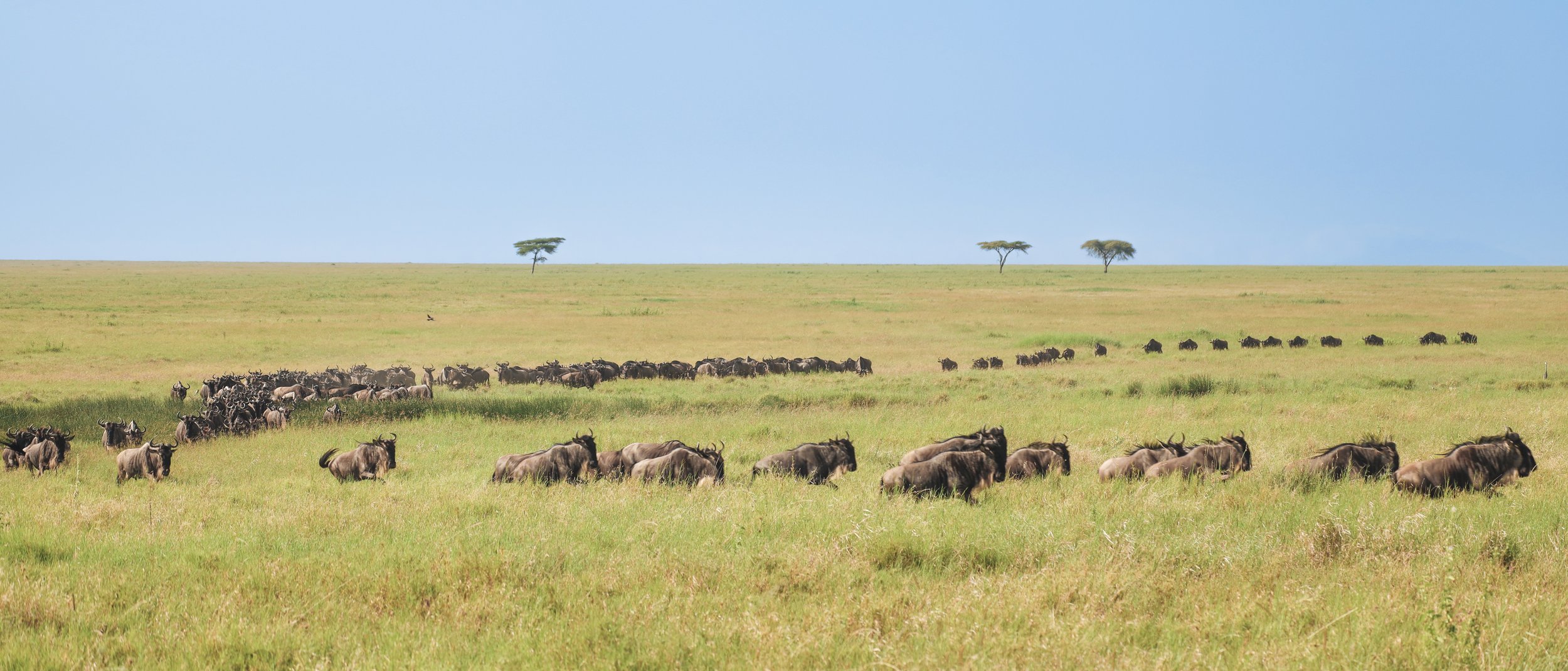
We spend about twelve days in the Serengeti. We go north and see wildebeest gathering, thousands of them moving as part of the great migration, crossing the Mara River on their way into Kenya. It’s one of the most important ecological systems on Earth, and to see it with your own eyes feels like watching the planet breathe.
When we first drive into the park, there are controlled burns happening. Smoke so thick you can’t see more than fifteen feet ahead. The sun becomes a red outline in the haze. And then over the weeks you can literally watch the land heal, charred black turning into bright green growth poking through like the earth refuses to stay quiet.
We see everything. Lions, leopards, serval cats, lilac breasted rollers, all kinds of beauty.
At one point there are like a hundred cars stopped to see a leopard and I shout a name across the vehicles because there’s another group out there. Another Moon Dance leader. We end up meeting up that night, kids meeting kids, leaders catching up. The world shrinks in the Serengeti in a way that feels impossible.
Isotak and Becoming Part of the Maasai World for a Minute
After the Serengeti, we go to Isotak Camps, spelled like a mouthful and remembered like a legend.
We stay in big canvas tents and get invited into Maasai cultural experiences that are not a performance. They’re a window. And if you show up with respect, they open it for you.
One day we build a traditional mud hut.
The frame is already up, but our job is to fill and finish. We haul rocks, collect termite dust, fetch water jugs, and then the big one, cow dung. Fresh cow dung.
The girls have to go into the cow pen, pick it up, put it into buckets, carry it back. We mix it with termite dust and water and smear it with our hands over the walls, shaping the hut like we’re part of the village for the day.
Some girls think it’s disgusting at first, and then they get into it. We do it twice, in two different spots, and by the end everyone is proud. Like we built something real. Because we did.
There’s a dance ceremony too.
The women hop and shrug their shoulders. The men jump. And because I’m the only guy with each session, I’m the one who has to jump over and over and over, and the girls are losing it laughing and cheering because it’s such a bizarre, beautiful situation.
They dress up in Maasai jewelry. It feels ritualistic, almost daily. Like culture that’s alive, not something behind glass.
Then I tell the Maasai guys I’m good at throwing spears.
They don’t believe me.
I tell them I threw javelin in college. I ask for a competition.
They throw. Then it’s my turn.
I pull it back like a javelin, and they’re like no no no don’t throw it like that. And then I launch it almost double what anyone else threw.
Throwing javelin internationally against Maasai warriors is not something I expected to add to my life story, but here we are.
We hike up the mountain near Isotak and see the whole Mto wa Mbu valley spread out below us. We go into the markets in Mto wa Mbu and I teach the girls how to barter. I show them what’s worth buying. I let them roam a little and discover the chaos and color on their own.
And then there’s the goat.
The Goat Sacrifice and the Raw Kidney
Each session, the Maasai offer a goat sacrifice because we’re having barbecue for dinner.
The first session we make a mistake. We don’t warn the girls. We just bring them and suddenly they’re watching the traditional killing technique, suffocation, and if necessary decapitation.
Some of them are furious. They feel blindsided. And honestly, I get it.
But I also tell them the truth. This is where meat comes from. Back home we buy it in plastic and forget that something living had to die. Here it’s direct. It’s sustainable. It’s pastoral. It’s reality.
We tour the village too. One ringed fence made of shrubs. Mud huts for the man and his wives. Other huts for wives and children. A central enclosure for goats and cows to keep them safe. Cows for milk and celebrations. Goats for meat.
After the goat is killed, they cut it open and take out the kidney. And in order to be strong, to be a warrior, you take a bite of the raw kidney.
First session, me and two girls do it.
Second and third sessions, almost everyone does it.
It’s crazy. It’s stepping across a line you didn’t know you could step across. It’s the girls proving to themselves they can handle something raw and real and uncomfortable. And I’m proud of them for it.
Lake Jipe: The Dusty Camp That Builds You
After Isotak, we do a massive transfer day, like fifteen hours in a bus, and make it to Lake Jipe on the border with Kenya.
Lake Jipe is dusty. It’s spiky. It’s not pretty in the polished way. The food isn’t great. It feels like the kind of place that grows on you because it forces you to bond.
We sit under a tent and play cards. We play soccer. We sit by the fire and tell stories. It becomes character building for everyone, the kind of discomfort that makes a group tighter.
We do a big hike, about 800 feet of elevation gain and then miles along a ridge. It’s hard. It’s long. It’s earned.
And then we do the canoe trip.
Canoes That Take on Water and Hippos Up Close
We meet fishermen in town. Each fisherman has a canoe that looks like it’s barely holding itself together, made of planks, barely a seat. Only one student fits with the guide.
As soon as you get into the boat, water starts pouring in.
So the guides pass around an empty milk jug and everyone is scooping water out constantly so we don’t sink.
We canoe out toward hippos, crossing into Kenyan waters to find a whole pod of them.
Every session has a moment.
On the last session, I’m in the back, the girls are ahead of me near the hippos. I watch one hippo go underwater, then pop up like twenty feet closer to the girls.
Then it goes back under.
And I don’t debate it. I yell time to stop, time to leave, we’re getting out of here.
Sometimes leadership is knowing when the story is about to turn into the wrong kind of story.
We leave, and it’s still incredible. Because we did it. We saw them. We got close. And we got out safe.
Eagle Point in Tanga: Beach, Bungalows, and the Last Bonfire
Then we go to Eagle Point in Tanga, and everything shifts.
Ocean air. Private beaches. Volleyball for hours. Snorkeling. Walking through the village and seeing how people live there.
We do a roti making class where the mamas teach the girls how to cook. It’s loud, hands on, full of laughter. The kind of day that makes you realize food is a language.
We stay in big bungalows right on the water. Open air rooms, no windows, just breeze. And wildlife everywhere. Hermit crabs. Bats. Bush babies.
There’s a giant lodge where we play games at night.
One night we do a Survivor style game where everyone is blindfolded, hands on mystery objects, screaming and laughing and grossed out in the best way.
And on our last night, we have the goodbye ritual.
A big bonfire.
We dance with locals. They teach us traditional beach dances around the fire. The girls love it every session, but on the last night it hits different. It’s the final exhale. The last party. The moment where you can feel the ending before it arrives.
We’ve been in Tanzania for a month and a half. Almost two months.
And now we’re saying goodbye.
Why Tanzania Stays With Me
I’ve been a lot of places. But Tanzania might be my favorite country I’ve ever been to.
The wildlife, obviously. The Serengeti sunsets and stars. The endless grasses, the way the land feels like it’s been doing this forever and will keep doing it long after I’m gone.
But more than that, it’s the people.
The kindness. The depth. The way of life that feels chill in a way America doesn’t know how to be.
As an American, it’s easy to look at people like the Maasai and label it poverty. But being there in person, it’s complicated. They don’t move through the world like they’re missing something. They move like they know exactly what matters.
Maybe that’s me romanticizing it as an outsider. Maybe it’s more layered than what I can see.
All I know is every time I go back to Africa, I come home different.
And being able to lead girls through their first elephant, their first Serengeti night, their first time realizing the world is so much bigger than the version they grew up with, that is one of the greatest privileges of my life.
Tanzania didn’t just give me memories.
It gave me a compass.