
India
Overstimulated Every Sense
Holi Colors, Fire on the Ganges, and the Silence of the Himalayas
I flew into India in the spring of 2024 on a one-way ticket from Hanoi to New Delhi, and I was nervous in a way I hadn’t been for the rest of my travels.
Southeast Asia had been social in an easy rhythm. Even when you were solo, you weren’t really alone. India felt different. A hard reset. New pace, new intensity, new kind of traveler. It felt like stepping into something that didn’t care whether you were ready or not.
So before I even left the airport, I did what I always do when I feel that invisible wall creeping in—I started a conversation.
That’s how I met Dana.
She was from Melbourne, a few years older than me, traveling with her friends Paul and Heather from England. When we landed in New Delhi, I met them too. Paul is a DJ and chef, Heather an actress and writer, and somehow the four of us clicked instantly—no effort, no awkwardness.
They dropped me at my hostel that first night, and I went straight to sleep, completely wrecked, knowing India was going to take more energy than I realized I had.
Delhi: The First Overload
The first thing I tell people about India is simple:
India overstimulates every sense to the maximum.
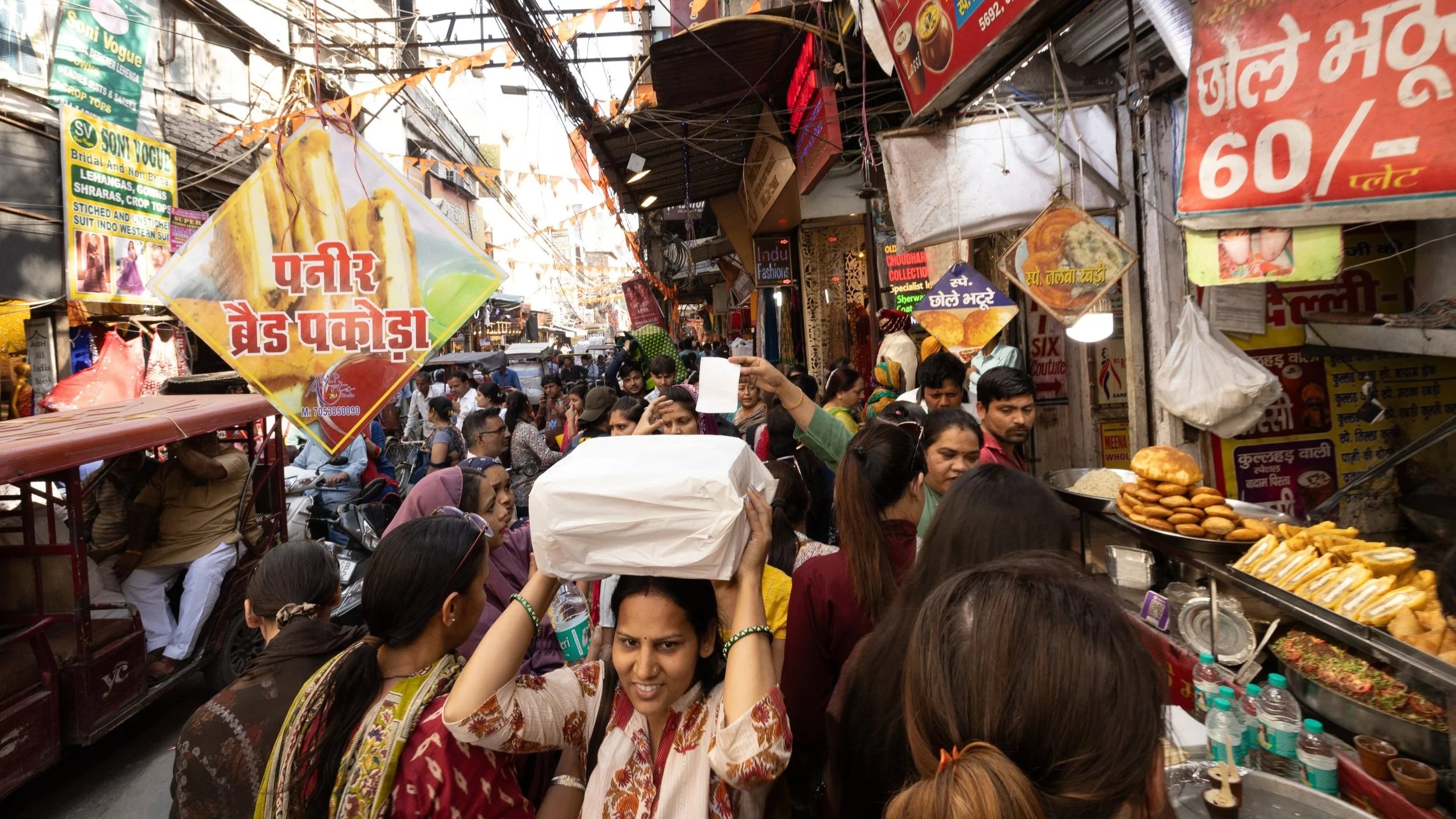
You hear everything. You smell everything. You see everything. And none of it is subtle.
My first impressions of Delhi were honestly negative. Dust in the air. Heat that clings to your skin. Smells that push right up against your tolerance. The constant awareness that you might get scammed. The constant need to be alert.
At the time, I didn’t understand yet that this same chaos would later become part of what I loved most.
My First Mistake
I learned quickly that going vegetarian early in India is a smart move.
I ignored that advice.
On my first meal with the group, I ordered chicken curry. I wanted comfort. I wanted something familiar.
I paid for it later.
That day, we walked around the city, bought clothes for Holi, and eventually met up with Paul’s friend Antrix, a local from Delhi. Riding through the city in a tuk-tuk with him felt unreal—narrow streets, people everywhere, no lanes, no pause.
At one point, the tuk-tuk bumped an older woman and a child, pinning them briefly against a utility box. The driver reversed, they stood up, and life continued like nothing happened.
Not because it was okay—but because the current never stops.
That night, Antrix took us to try paan, a betel leaf mouth-freshener layered with spices and sweetness. Paul tried it and described it like a full sensory explosion. I didn’t. My stomach was already done negotiating.
Holi in Hauz Khas Village
That night, I got violently sick.
Bent over a toilet, thinking, This is my first week in India. Incredible timing.
And the next morning was Holi—the reason I came to India.
I rallied. Slowly. Put on the Holi shirt. And went to meet the group in Hauz Khas Village.
When I found them, they were already soaked and covered in color—greens, blues, reds—kids from the neighborhood had completely ambushed them. We didn’t celebrate Holi in a massive tourist crowd. We celebrated it locally, in an alleyway street party.
Families poured out into the narrow streets. Kids threw powder and water balloons from every direction. One large family pulled us into their alley with open arms, and suddenly we were dancing, singing, laughing, and completely submerged in color.
It wasn’t performative. It wasn’t curated.
It was warm. Human. Real.
That day changed everything for me. India stopped feeling hostile and started feeling alive.
Later, when we were still covered head to toe in color and desperately looking for food, two Indian girls struck up a conversation and simply helped—walking us to a place where we could eat, recover, and breathe again.
When I finally got back to my hostel and tried to wash the color off, I realized Holi doesn’t really leave you. The stains stayed on my skin for days.
Proof.
The Taj Mahal at Sunrise
Not long after, we found ourselves in Agra, waking up before sunrise to see the Taj Mahal.
You see pieces of it first—the dome, the spires—but when you walk through the main gate and it fully reveals itself, it doesn’t feel real. It looks like a monument built out of light.
It was quiet that early. Soft. Almost reverent.
One guy we met tried to do a handstand in front of it and nearly got kicked out—apparently yoga poses are not allowed—but even that felt surreal in the moment.
Jaipur and Finding Community
In Jaipur, the thing that surprised me most wasn’t the forts or the pink architecture—it was the people.
The hostel became its own little universe. Travelers from all over the world eating together, singing karaoke at night, staying up late talking about why we were there.
That was the most community I felt anywhere in India.
And yes—at one point, I watched a man ride an elephant down a main road like it was completely normal. That image is burned into my brain forever.
Varanasi: Life and Death Without Distance
Then I went to Varanasi.
Varanasi was my favorite place in India. It might be one of the most powerful places I’ve ever experienced.
Walking along the Ganges River, you see everything at once—people bathing, praying, washing clothes, singing, sitting silently.
And people being cremated.
I watched the live cremation of an elderly woman while her family stood nearby. Her body, wrapped and placed on the pyre, slowly changed as the fire took over. Her skin melted and folded in on itself, almost like melting ice cream, reshaping into something unrecognizable.
It wasn’t grotesque. It was sobering. Honest. Final.
This wasn’t hidden away. It was part of daily life. Death wasn’t separated from the living—it existed alongside it.
At night, ceremonies along the river filled the air with chanting, music, fire, and flowers. Thousands of people packed together so tightly you could barely move. Varanasi doesn’t let you observe from a distance. It pulls you in whether you’re ready or not.
I met Indian guys who walked with me along the ghats, explained the rituals, shared food, and talked about their own hopes of one day being cremated there. If you want to understand India, let Indian people show it to you.
Manali and the Himalayas
After the intensity of the cities, Manali felt like relief.
Clean air. Quiet. Mountains.
I rented a scooter and rode everywhere—through town, up into the mountains, to trailheads, to nowhere in particular. The landscape reminded me of Glacier National Park, except taller, sharper, and still snow-covered in spring.
One day, I rode through the Atal Tunnel, a long, cold 10-kilometer tunnel connecting Solang to Sissu. It was dark, freezing, and just uncomfortable enough to keep you completely focused.
I attempted a hike toward Patalsu Peak, pushing into deep snow until every step sank to my waist. Without proper avalanche knowledge or gear, I stopped.
Instead of chasing the summit, I sat down, ate lunch, and stared at the scale of the mountains.
And I felt incredibly lucky.
That moment mattered more than any peak.
One morning in Manali, I woke up before sunrise with one goal in mind: Patalsu Peak.
I had found the route on AllTrails, saw the elevation gain, saw the mileage, and thought, I can do that. I rented a scooter, layered up as best I could with what I had, and rode out while the mountains were still quiet. The air was cold enough to sting, and the roads were nearly empty. It felt like the kind of morning where something important might happen.
The hike itself was no joke. This wasn’t a casual walk into the hills — it was long, sustained, and demanding. The trail climbed steadily through forests and open terrain, and with every step, the mountains around me grew bigger, more imposing, more real. Snow started appearing early, then more consistently, until the landscape turned almost entirely white.I didn’t have snowshoes. I didn’t have avalanche gear. I didn’t grow up in snow-heavy mountain environments. But I kept going.
Eventually, I reached a massive open snowfield. Every step forward meant sinking deeper — at first to my shins, then my knees, then my thighs. Eventually, every step dropped me nearly to my waist. The kind of effort where your heart is pounding, your legs are burning, and progress slows to almost nothing.I stopped.I realized I didn’t fully understand the risks of where I was standing. Avalanches don’t announce themselves. Snow doesn’t need permission. And I knew enough to know that not knowing enough was reason to pause.
I sat down right there in the snow, pulled out my food, and ate lunch surrounded by the Himalayas. The mountains were massive beyond anything I’d experienced before — layered ridgelines fading into the distance, peaks still holding winter, silence so complete it felt heavy.There was no disappointment.Only gratitude.
I sat for a long time before turning back, letting the scale of the place sink in. And as I descended, I realized that moment — stopping when I did — was one of the most meaningful parts of my entire time in India.
Old Delhi and the Real Takeaway
One day, Dana and I explored Old Delhi. Walking those streets with my camera felt like watching a thousand stories unfold at once—vendors cooking for crowds, men sleeping on carts, cows standing in traffic like they owned it.
It was chaotic. Alive. And required awareness.
India asks you to be open—and alert—at the same time.
But my biggest takeaway from India wasn’t a landmark.
It was friendship.
Dana, Heather, and Paul shaped the experience in ways no place could. Later, I even visited Paul and Heather in London—one of those gifts travel gives you when you say yes to people.
India isn’t for everyone.
But if you feel even a small pull toward it, I think it’s worth going.
It’s intense. It’s beautiful. It’s exhausting. It’s kind.
And it will change how you see the world.